

When it comes to cooling homes, offices, or commercial buildings — especially in climates like Dubai — selecting the right air conditioning system is crucial. Whether you are a homeowner or a building manager exploring options offered by air conditioning companies in Dubai,understanding the different types of air‑conditioning solutions can help you choose what fits your needs best. Below, we break down the most common types of air‑conditioning systems, their uses, advantages, and limitations.

1. Window (Mono) / Portable Air Conditioners
Also known as mono‑unit air conditioners, these are stand‑alone units that house both the evaporator and condenser in a single module, typically mounted in a window or a wall opening, or on castors/floor in the case of portable units.
Ideal for: small rooms or spaces where permanent installation is not feasible — for instance, small apartments, rental rooms, or temporary setups.
Pros
- Affordable and easy to install. No need for separate outdoor and indoor units.
- Convenient when ductwork or permanent AC infrastructure is not possible.
Cons
- Cooling capacity is limited; it is not meant for large spaces or a whole home.
- Usually, it is less energy-efficient compared with split or central systems.
- Possible to be noisier
Portable air conditioners can be a quick, low‑cost fix — but are usually a stopgap rather than a long-term solution.
2. Split and Multi‑Split Air Conditioners
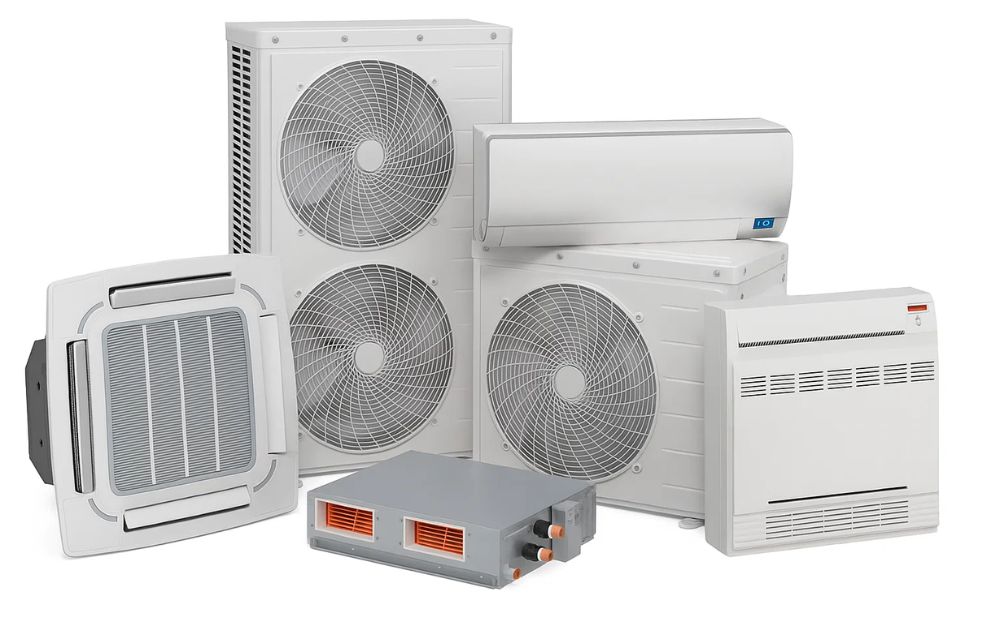
One of the most popular AC types worldwide, split systems divide the air conditioner into two main parts: an outdoor unit (compressor and condenser) and an indoor unit (evaporator and fan/air handler).
- Single‑split systems: One indoor unit connected to one outdoor unit — ideal for one room or a small apartment.
- Multi-split systems: One outdoor unit connected to multiple indoor units, allowing independent control in different rooms.
Ideal for: Residential homes, apartments, small offices — anywhere you want a balance between power, flexibility, and efficiency.
Pros
- More effective and powerful than window/portable units.
- Flexibility: multi-split systems allow different rooms to be cooled independently without multiple outdoor units.
- Easier maintenance compared to large central systems.
Cons
- The initial installation is costlier compared to a window or portable AC.
- For larger buildings or multiple floors, running multiple outdoor units can get cumbersome.
For many homes and small businesses, split and multi-split systems offer the ideal balance of cost, efficiency, and comfort.
3. Ducted Central / Packaged Air Conditioning Systems
For larger buildings, like villas, big homes, hotels, or commercial establishments, ducted central or packaged systems are commonly the better fit. Such a setup implies that the air is cooled at a central place, an outdoor or rooftop unit, followed by the distribution of cooled air to many rooms through a network of ducts and vents.
Sometimes, “packaged” units, where all the components are housed in one large cabinet, are used, often mounted on rooftops or mechanical rooms.
Ideal for: large homes, multi‑story buildings, hotels, offices — especially where uniform cooling or centralized climate control is required.
Pros
- Efficient and powerful to cool large volumes of space.
- Clean, centralized installation – no multiple indoor units cluttering rooms.
- Often offers better long-term energy efficiency than multiple split units if properly designed and maintained.
Cons
- Requires ductwork, which adds to installation cost and complexity.
- Maintenance and servicing can be more involved compared to split systems.
For large spaces and buildings, ducted central systems remain a go-to solution, especially when uniform comfort and discrete installations matter.
4. Advanced: VRF / VRV (Variable Refrigerant Flow/Volume) Systems
Variable Refrigerant Flow-VRF (sometimes also referred to as VRV for Variable Refrigerant Volume) represents the cutting edge of modern AC technology, and it will offer flexible, efficient, zone‑wise climate control.
A VRF system has one outdoor condensing unit that is connected to several indoor units through refrigerant piping, not bulky ducts. The refrigerant flow to each indoor unit is varied depending on demand so that the rooms can be independently cooled or heated at different intensities.
Some versions allow cooling and heating simultaneously in different zones of the building; among such systems are heat-recovery VRF systems.
Ideal for: Medium to large residential projects, apartments, multi-zone offices, hotels, basically any building needing zoned, flexible climate control without ductwork.
Pros
- Highly energy-efficient thanks to variable compressor/inverter technology.
- Fine temperature control per zone, great for buildings with very varied thermal loads.
- Quiet operation, and installation is often more straightforward compared to ducted systems if space or aesthetics are an issue.
Cons
- Higher initial cost than split or window AC units.
- Though installation can be flexible, proper design and professional setup are conducive to maximum benefits.
- Specialized technicians may be needed for maintenance.
Due to the aforementioned reasons of flexibility and efficiency, VRF technology finds increasing applications in modern buildings that require robust, comfortable, and scalable AC solutions, especially when dealing with “air conditioning companies in Dubai” for bigger projects.
5. Other / Specialized Solutions
Beyond the mainstream categories above, there are specialized HVAC setups for particular needs:
- Constant Air Volume, or CAV, systems: are usually used in small buildings and/or residences for simple, reliable air supply with a fixed airflow rate.
- Heat Pump Systems: Some ACs also double up as heaters in colder seasons; they are versatile enough for annual climate control.
- Ventilation & Air-Purification systems: These are systems that integrate AC with air filtering or purification to improve indoor air quality. It is often relevant in commercial kitchens, hospitals, hotels, or spaces with high indoor occupancy.
Large companies, such as Airody, the leading manufacturer of ventilation products in the Middle East, offer a whole range of these specialized solutions and more.
Which System Should You Choose?
The right air-conditioning solution depends first on:
- Space size: small rooms → window or split AC, large buildings → ducted central or VRF.
- Budget/long-term costs: Window/portable AC has the lowest upfront cost; VRF and ducted systems possibly yield lower running costs over time.
- Flexibility & zoning needs: Multi-split or VRF for room‑wise control; central systems for unified climate.
- Installation constraints: ductwork availability, outdoor unit placement, ventilation needs, and maintenance access.
- Use Case/Occupancy: Residential Apartment vs. Hotel vs. Office vs. Commercial Kitchen
In most modern homes and offices, the combination of split and VRF systems with good ventilation and purification strikes the best balance between comfort, efficiency, and control.
Conclusion
The choice of air conditioning depends upon your space, needs, and comfort goals in the long run. Whether it’s a small home that just needs a simple split AC or a large commercial building that opts for a VRF system, it’s all about matching the strengths of the system with your requirements. When it comes to air conditioning companies in Dubai for AC and ventilation solutions, working with a trusted name like Airody Trading LLC ensures that one gets access to top-quality and comprehensive systems, not just AC but a ventilation ecosystem that caters to the demands of a modern building. By understanding the strengths and limitations of each type — window, split, ducted, VRF, or specialized HVAC — you can make an informed choice that balances cost, efficiency, and comfort.