

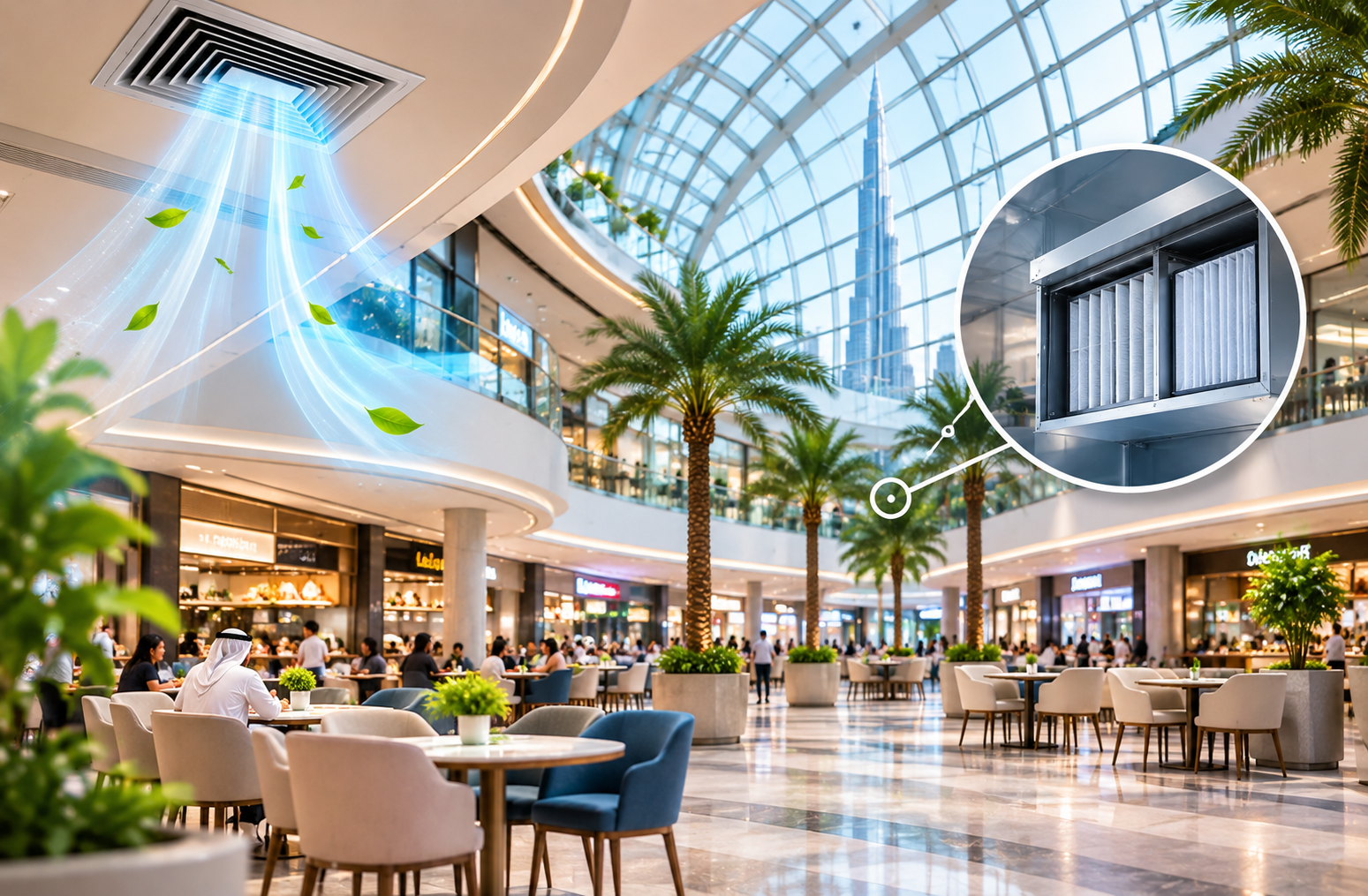
How Dubai Malls Can Improve Food Court and Atrium Air Quality
It is one of the toughest buildings to maintain freshness of, one could say a mall. Thousands of people walk through each day, all the doors are open to hot, dusty air and dozens of kitchen areas are emitting smoke and cooking vapour all under the same roof. The outcome is a space with a wide range of air quality from one area to another. Although they might not talk about the issue, a shopper will feel the stuffy corners and odours, and keep the fresh air in their memory. For operators, a well-planned Mall Air Purification System is part of delivering a comfortable, welcoming experience.
Why Malls Face Special Challenges
Food courts. Frying, grilling and tandoor cooking produce grease, smoke and odour that can drift into seating areas. Shared exhaust systems may serve many tenants, and one poorly maintained kitchen can affect the whole floor.
Atriums. Large open volumes are difficult to ventilate evenly. Warm air rises, cool air sinks and dust settles unevenly. The height of an atrium can create stratification, leaving occupied zones too warm or poorly ventilated.
Entrances and car park connections. Dust, exhaust fumes and humidity enter with visitors, especially during dust events or hot, humid weather.
High occupancy. More people means more carbon dioxide, body heat, moisture and airborne particles per square metre.
What Poor Air Quality Looks Like
Persistent cooking smells, dust on surfaces, unusual stuffiness, tenants components complaining of stuffiness, grease deposits around exhaust areas and uneven temperatures are all warning signs. Other mild symptoms such as headaches or irritated eyes can also be present but have numerous causes and shouldn’t be taken as an indicator of the building only.
Practical Steps to Improve Air Quality
- Start with ventilation. Aim for balance with sizing for occupancy with fresh air supply exhaust. An HVAC expert can identify under-ventilated areas and modify the airflow, damper positions and control configuration.
- Control kitchen emissions at the source. Food court kitchens should have grease filters, exhaust hoods and, where required, treatment equipment such as electrostatic or carbon-based units. Regular cleaning of hoods and ducts is essential for both air quality and fire safety.
- Upgrade filtration in the air handling units. Higher-efficiency filters capture finer particles, but the system must be able to handle the added resistance. Staged filtration, with pre-filters protecting finer stages, usually performs best.
- Add targeted purification. Depending on the space, solutions can include in-duct filtration, UV treatment at coils and carbon media for odour. A Large Area Air Purification System can complement central ventilation in zones such as food courts and atriums where loads are high.
- Manage pressure between zones. Food courts should generally sit under slightly negative pressure compared with surrounding retail areas, so cooking odours are drawn toward exhaust points instead of drifting outward. Entrances benefit from air curtains or vestibules.
- Monitor, don’t guess. Sensors for particulate matter, carbon dioxide, temperature and humidity give operators real data. Trends help identify problem zones and show whether improvements are working.
Maintenance Is Part of the Solution
Even the most sophisticated equipment will not operate smoothly without maintenance. Set up maintenance plan for filter changes, coil cleaning, duct inspection and kitchen exhaust cleaning. Up up the frequency during dust season. Maintain records, and clarify tenant’s duties for exhaust systems. New tenants may have fit out mandates that specify the exhaust and filtering conditions.
Communicating With Tenants and Visitors
When the goals are known, it’s easier to manage the air quality. Provide tenants with guidelines, get their complaints attended to promptly, and monitor outcomes. Sightly changes, including improved seating surfaces, less foul odour, help to increase customer satisfaction and lengthen stay.
Why Consider Airody Trading
Airody Trading is involved in the air quality and filtering industry in UAE. It can be good practice to discuss with their team the layout, problem areas and technology possible at your mall. If you are planning a Mall Air Purification System upgrade, visit their website to learn more and request advice.
Frequently Asked Questions
1. Can an air purifier remove cooking odours completely?
Not always. Odour control usually needs a combination of source capture, good exhaust, carbon filtration and proper ventilation. Purifiers help, but they work best as part of a complete strategy.
2. How often should mall air filters be changed?
This depends on the type of filter, the amount of dust and the hours of operation. Filters are more frequently checked during the dust season, and replaced as needed, based on pressure drop and manufacturer’s recommendations, by many facilities.
Final Thoughts
The improvement of the purity of malls air is not just obtained from one product. This is achieved through a balance of ventilation, controlling emissions in the kitchen, filter and regular maintenance. Food courts and atriums are a place where food can feel fresher, healthier and more welcoming with the right plan. A carefully designed Mall Air Purification System is a worthwhile step in that direction. This article is general information and not engineering or medical advice.