HEPA vs Electrostatic vs UV-C vs Ozone: Which Commercial Air Purifier Is Right for Your Building?
What was once a background issue has become a matter for the boardroom. Cleaner air is desired in offices, clinics, schools, hotels and restaurants–where there are found to be a variety of technologies, some better adapted to occupied spaces than others. The wrong choice could cost you or cause additional issues. This guide compares four common approaches so you can ask better questions when specifying a Commercial Air Purifier Dubai buildings can depend on.
HEPA Filtration
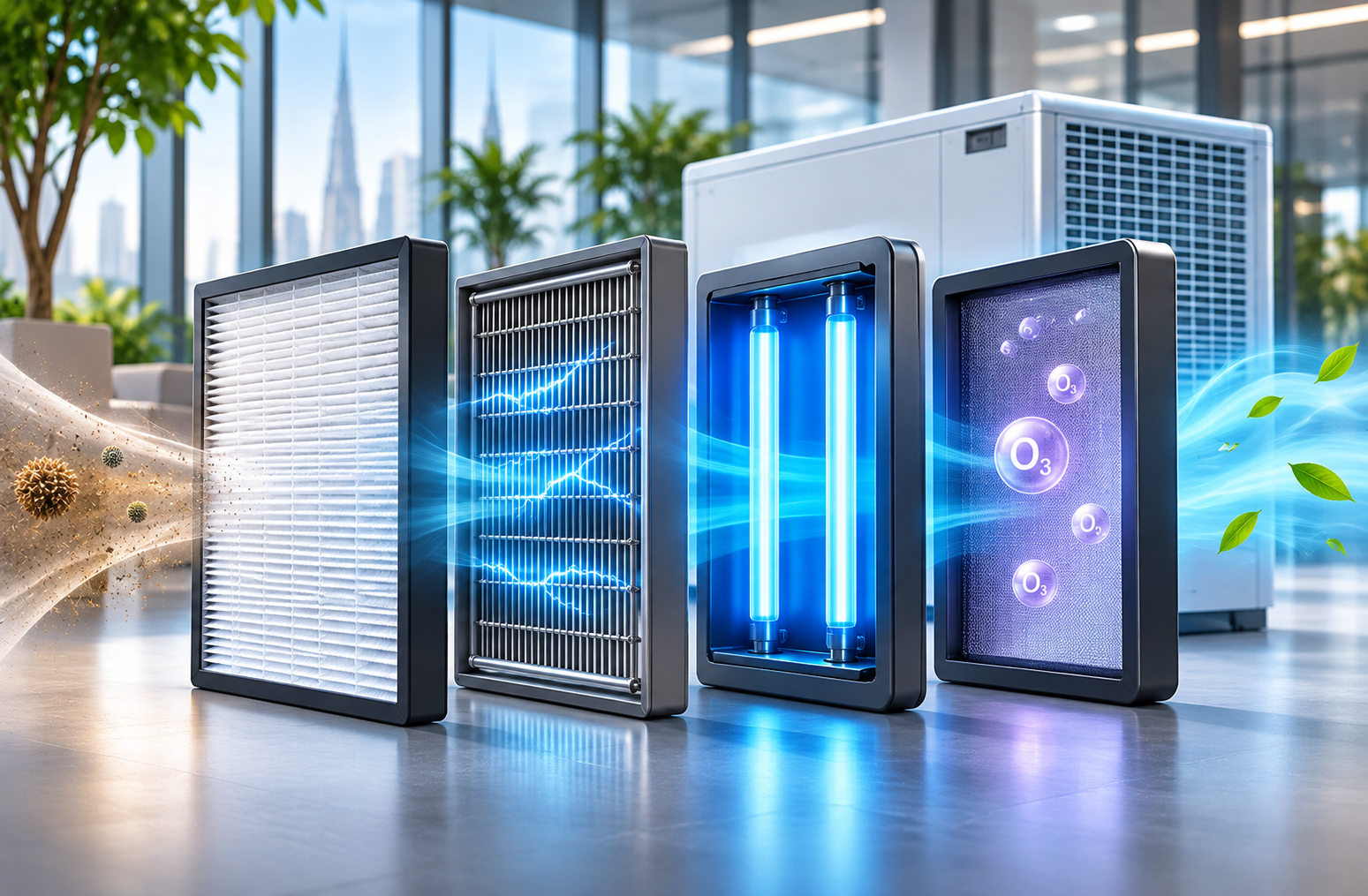
The HEPA is a high-efficiency particulate air filter. True HEPA filter is a tightly packed mat of very small fibres which physically catches particles as they move through the filter. As per standard test conditions, it should retain at least 99.97% of the particles of the size which is most difficult to be filtered, i.e. size of 0.3 microns. Filters dust, pollen, particles of smoke and numerous bacteria and mould spores bound to the particles.
Strengths: Proven, no harmful by-products, effective on a wide range of particles.
Limits: Does not remove gases or odours on its own, creates airflow resistance and filters need regular replacement.
Facilities looking at HEPA Air Filtration Dubai options usually value its reliability in clinics, laboratories and offices.
Electrostatic Purifiers
These units charge particles and then collect them on oppositely charged plates, or use charged filter media. Electrostatic precipitators are common in kitchen extraction and some HVAC applications.
Strengths: Low airflow resistance, reusable collector cells that can be washed and good performance on fine smoke and grease particles.
Limits: Cells need regular cleaning to stay efficient, some designs can produce small amounts of ozone and performance depends on design and maintenance.
An Electrostatic Air Purifier Dubai buyers consider should be checked for ozone emission levels and appropriate certification.
UV-C Treatment
UV-C light, a short-wavelength ultraviolet, can damage the genetic material of microorganisms, preventing them from reproducing. In buildings, it is used inside ducts, across coils or in enclosed purifier chambers.
Strengths: Helps reduce microbial growth on coils and surfaces, and can supplement filtration.
Limits: Effectiveness depends on dose, meaning intensity multiplied by exposure time. Air that moves quickly past a lamp may not receive enough. UV does not remove particles, and lamps lose output over time and need replacement. Direct exposure harms eyes and skin, so units must be properly shielded.
Anyone exploring UV Air Purification Dubai solutions should ask for performance data for the specific airflow and lamp arrangement.
Ozone Generators
Ozone is a reactive gas that can break down certain odours and organic compounds. Some products generate it deliberately to treat air or surfaces.
Strengths: Can reduce strong odours in vacant, controlled situations.
Limits: Ozone is a lung irritant, even at low concentrations, and can worsen asthma and other respiratory conditions. It can also react with other substances to form by-products. Health authorities generally advise against using ozone-generating devices in occupied spaces. For most commercial buildings, it is not a suitable choice for everyday air cleaning.
Side-by-Side Summary
- Particles: HEPA and electrostatic are the strongest.
- Microbes: UV-C can help, particularly with filtration.
- Odours and gases: Activated carbon or other media are needed, since HEPA and UV do not remove gases effectively.
- Safety in occupied spaces: HEPA is the most straightforward. Ozone is the most problematic.
- Maintenance: Filters need replacing, electrostatic cells need cleaning and UV lamps need periodic replacement.
How to Choose
Begin with the problem – dust, smoke, allergens, microbes or odours. Take room size, ventilation, load and present HVAC systems into account. Several technologies, such as pre-filters, HEPA stages and UV, are integrated into many buildings to provide a range of technologies for various needs. Request testing information, certifications, and maintenance recommendations, but don’t buy products that guarantee to get rid of everything.
Why Consider Airody Trading
Airody Trading operates in the field of air quality and Air Filtration industry in the UAE. A meeting with their staff is an effective exercise to understand your building, your objectives and technologies that will fit. If you are comparing a Commercial Air Purifier Dubai project, visit their website to learn more and request advice.
Frequently Asked Questions
1. Which technology is best for an office?
For general offices, HEPA-based filtration, sometimes combined with carbon for odours, is usually the safest and most dependable option. The right choice still depends on your space and HVAC.
2. Is ozone safe to use in occupied rooms?
Generally not. Ozone can irritate the lungs, and many health authorities advise against using ozone generators where people are present.
Final Thoughts
As with all technologies, each has its role to play, but there are no silver bullets. Match the solution to a real AQ problem, demand safety and performance data and think about maintenance. A carefully specified Commercial Air Purifier Dubai system can improve